2025.12.02 C语言程序设计上机实习五
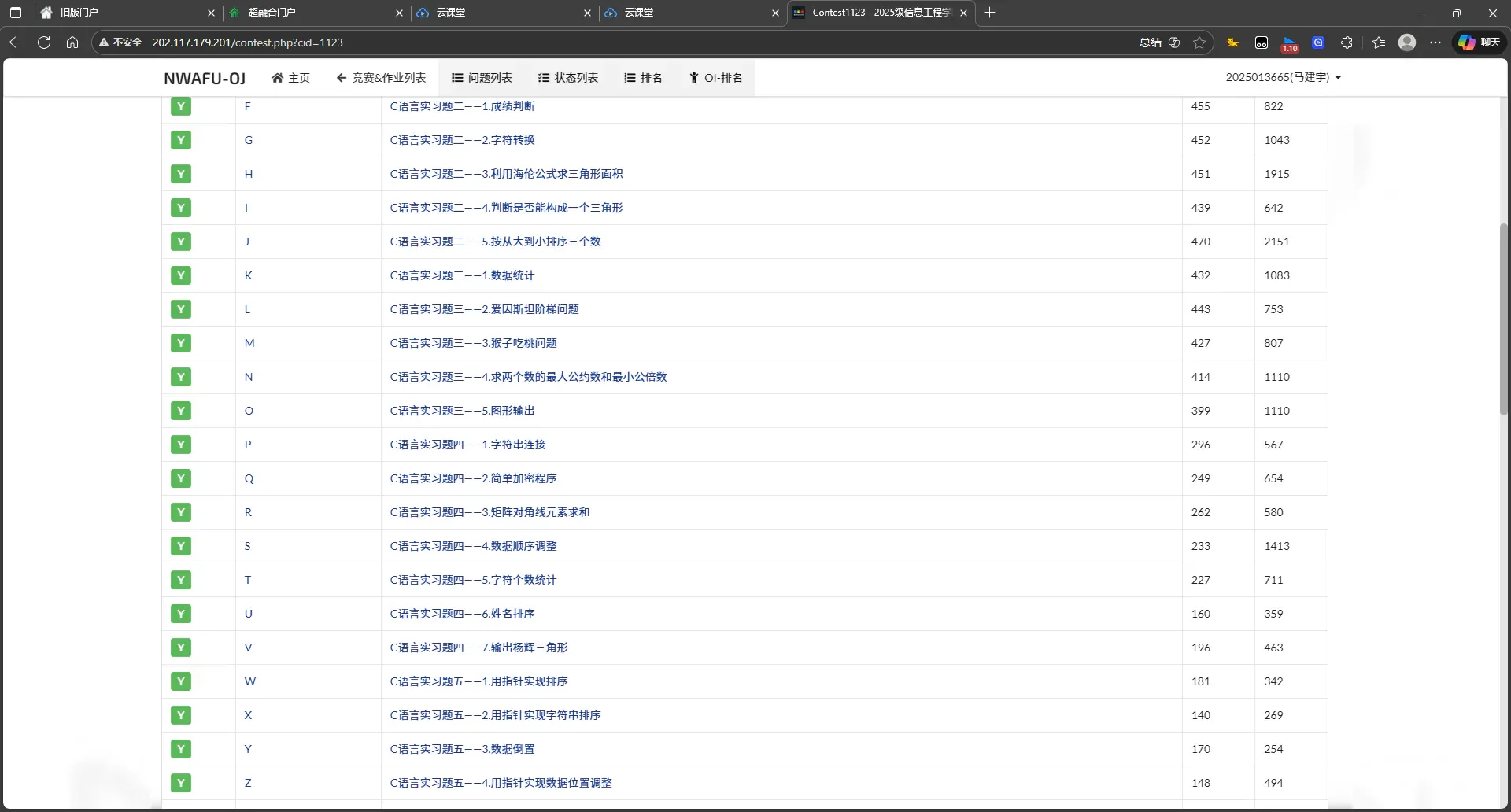
必做题
选做题
题目源文件实验五.pdf
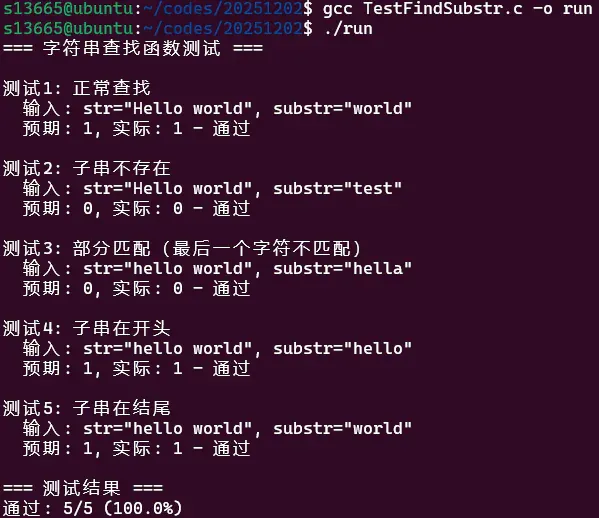
题目1:字符串查找函数
int FindSubstring(const char* str, const char* substr)
{
    if (!str || !substr) return -1;

    int n = strlen(str);
    int m = strlen(substr);

    if (m == 0) return 0;

    for (int i = 0; i <= n - m; i++)
    {
        int j = 0;
        while (j < m && str[i + j] == substr[j])
        {
            j++;
        }
        if (j == m)
        {
            return 1;
        }
    }

    return 0;
}
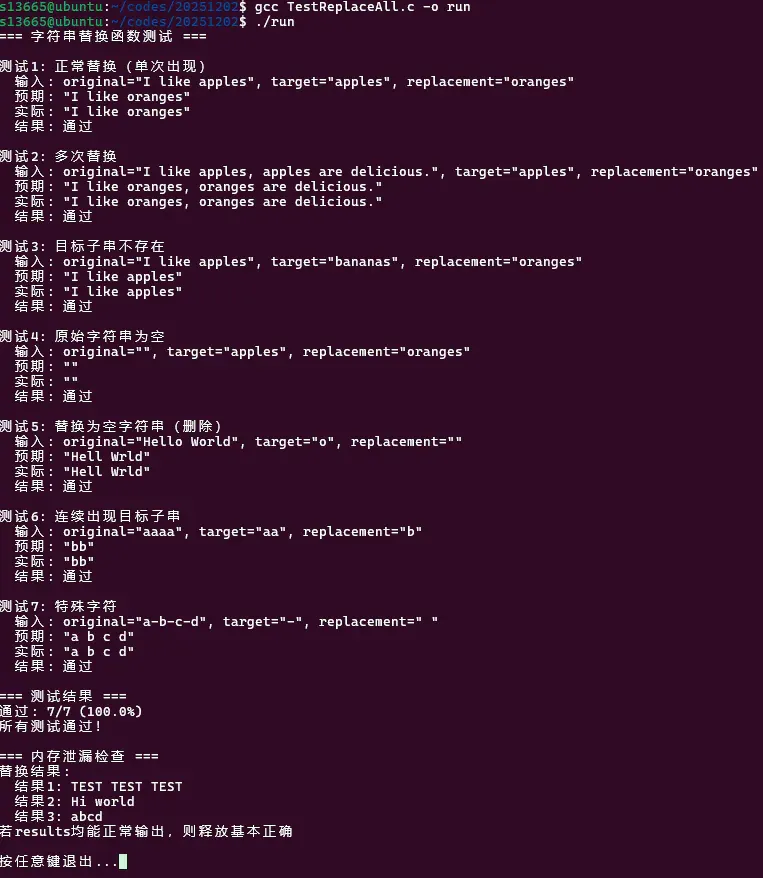
题目2:字符串替换函数
// 字符串替换函数实现
char* ReplaceAll(const char* original, const char* target, const char* replacement)
{
    // 检查参数是否为空
    if (original == NULL || target == NULL || replacement == NULL)
    {
        return NULL;
    }

    // 计算各字符串长度
    int orig_len = strlen(original);
    int target_len = strlen(target);
    int repl_len = strlen(replacement);

    // 如果目标字符串为空,返回原字符串的副本
    if (target_len == 0)
    {
        char* result = (char*)malloc((orig_len + 1)*sizeof(char));

        if (result == NULL)
        {
            return NULL;
        }

        strcpy(result, original);
        result[orig_len] = '\0';
        return result;
    }

    // 计算需要替换的次数
    int count = 0;
    const char* pos = original;

    while ((pos = strstr(pos, target)) != NULL) // strstr的用法在课本P486
    {
        count++;
        pos += target_len; // 跳过已找到的目标字符串
    }

    // 计算新字符串长度
    int new_len = orig_len + count * (repl_len - target_len);
    char* result = (char*)malloc((new_len + 1)*sizeof(char));

    if (result == NULL)
    {
        return NULL;
    }

    // 执行替换操作
    char* current = result;
    const char* start = original;
    const char* found;

    while ((found = strstr(start, target)) != NULL)
    {
        // 复制目标字符串之前的部分
        int prefix_len = found - start;
        if (prefix_len > 0)
        {
            strncpy(current, start, prefix_len);
            current += prefix_len;
        }

        // 复制替换字符串
        if (repl_len > 0)
        {
            strcpy(current, replacement);
            current += repl_len;
        }

        // 移动到下一个位置
        start = found + target_len;
    }

    // 复制剩余部分
    strcpy(current, start);
    result[new_len] = '\0';
    return result;
}
修改部分:
- malloc用法,长度*sizeof(类型)
- strcpy复制位置(原有-1删去)(两处)
- result字符串末尾要加 ‘\0’ (两处)
- (无用)加入 repl_len > 0 判断
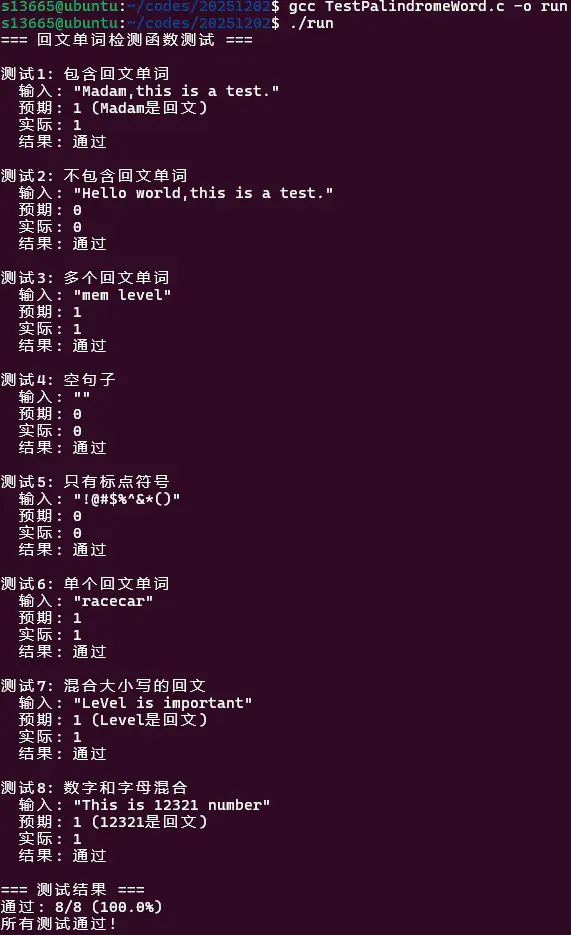
题目3:回文单词检测函数
int HasPalindromeWord(const char* sentence)
{
    if (sentence == NULL)
        return -1; // 传空参数处理

    const char* p = sentence;
    while (*p) {

        while (*p && !isalnum(*p)) // 字母与数字可过,略过字符
        {
            p++;
        }

        if (*p == '\0') // 如果因为上一个while跳到结尾了就该抓紧终止了
        {
            break;
        }

        const char* start = p;

        while (*p && isalnum(*p)) // 来个字母和数字作为起点,读到不是字母和数字和'\0'就停
        {
            p++;
        }
        const char* end = p;

        unsigned int len = end - start;
        if (len >= 2) {
            size_t i = 0, j = len - 1;
            int is_pal = 1;
            while (i < j) {
                char a = (char)tolower(start[i]);
                char b = (char)tolower(start[j]);
                if (a != b)
                {
                    is_pal = 0;
                    break;
                }
                i++;
                j--;
            }
            if (is_pal)
                return 1;
        }
    }

    return 0;
}
题目4:礼貌数判断函数(被放弃的期中考试题)
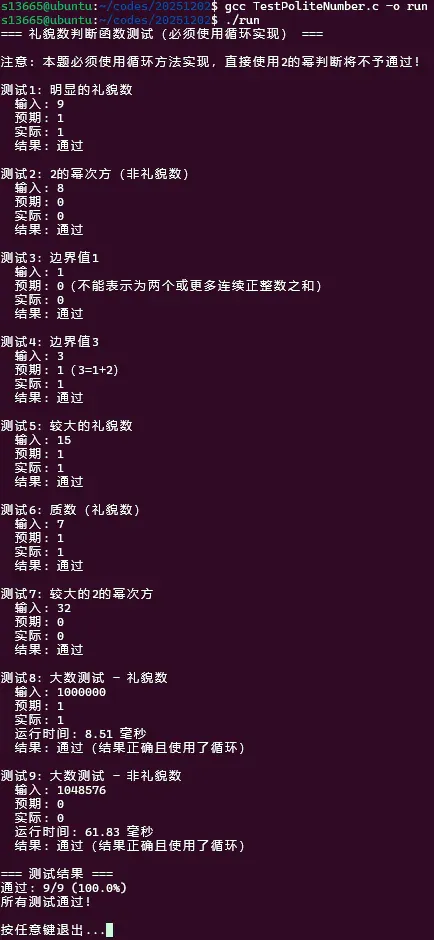
int IsPoliteNumber(int n)
{
    int test = n, sum = 0;
    for (int i = 1; i <= test; i++)
    {
        for (int j = i; j < test; j++)
        {
            sum += j;
            if (sum == test)
            {
                return 1;
            }
            else if (sum > test)
            {
                break;
            }
        }
        sum = 0;
    }
    return 0;
}
题目5:矩阵转置函数
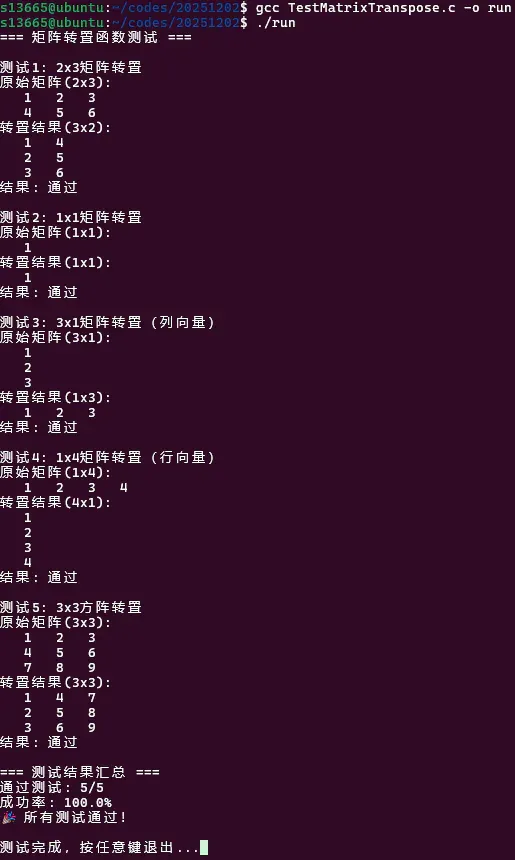
int** TransMat(int** matrix, int m, int n)
{
    int **arr;
    arr = (int **)malloc(n * sizeof(int *));
    for(int i = 0; i < n; i++)
    {
        arr[i] = (int *)malloc(m * sizeof(int));
        if(arr[i] == NULL)
            return NULL;
        for(int j = 0; j < m; j++)
        {
            arr[i][j] = matrix[j][i];
        }
    }
    return arr;
}
附:完整代码
TestFindSubstr.c
#include <stdio.h>
#include <string.h>

// 字符串查找函数声明
int FindSubstring(const char* str, const char* substr);
// 测试函数
void run_tests();

int main() {
    run_tests();
    return 0;
}

// 测试函数
void run_tests()
{
    printf("=== 字符串查找函数测试 ===\n\n");

    int pass_count = 0;
    int total_count = 0;

    // 测试用例1:正常情况
    printf("测试1: 正常查找\n");
    int result1 = FindSubstring("Hello world", "world");
    int expected1 = 1;
    printf("  输入: str=\"Hello world\", substr=\"world\"\n");
    printf("  预期: %d, 实际: %d - %s\n", expected1, result1,
           result1 == expected1 ? "通过" : "失败");
    if (result1 == expected1)
            pass_count++;
    total_count++;

    // 测试用例2:不存在的情况
    printf("\n测试2: 子串不存在\n");
    int result2 = FindSubstring("Hello world", "test");
    int expected2 = 0;
    printf("  输入: str=\"Hello world\", substr=\"test\"\n");
    printf("  预期: %d, 实际: %d - %s\n", expected2, result2,
           result2 == expected2 ? "通过" : "失败");
    if (result2 == expected2)
            pass_count++;
    total_count++;

    // 测试用例3:部分匹配但最后一个字符不匹配
    printf("\n测试3: 部分匹配(最后一个字符不匹配)\n");
    int result3 = FindSubstring("hello world", "hella");
    int expected3 = 0;
    printf("  输入: str=\"hello world\", substr=\"hella\"\n");
    printf("  预期: %d, 实际: %d - %s\n", expected3, result3,
           result3 == expected3 ? "通过" : "失败");
    if (result3 == expected3)
            pass_count++;
    total_count++;

    // 测试用例4:开头匹配
    printf("\n测试4: 子串在开头\n");
    int result4 = FindSubstring("hello world", "hello");
    int expected4 = 1;
    printf("  输入: str=\"hello world\", substr=\"hello\"\n");
    printf("  预期: %d, 实际: %d - %s\n", expected4, result4,
           result4 == expected4 ? "通过" : "失败");
    if (result4 == expected4)
            pass_count++;
    total_count++;

    // 测试用例5:结尾匹配
    printf("\n测试5: 子串在结尾\n");
    int result5 = FindSubstring("hello world", "world");
    int expected5 = 1;
    printf("  输入: str=\"hello world\", substr=\"world\"\n");
    printf("  预期: %d, 实际: %d - %s\n", expected5, result5,
           result5 == expected5 ? "通过" : "失败");
    if (result5 == expected5)
            pass_count++;
    total_count++;

    // 汇总结果
    printf("\n=== 测试结果 ===\n");
    printf("通过: %d/%d (%.1f%%)\n", pass_count, total_count,
           (float)pass_count/total_count*100);
}

int FindSubstring(const char* str, const char* substr)
{
    if (!str || !substr) return -1;

    int n = strlen(str);
    int m = strlen(substr);

    if (m == 0) return 0;

    for (int i = 0; i <= n - m; i++)
    {
        int j = 0;
        while (j < m && str[i + j] == substr[j])
        {
            j++;
        }
        if (j == m)
        {
            return 1;
        }
    }

    return 0;
}
TestReplaceAll.c
#include <stdio.h>
#include <stdlib.h>
#include <string.h>

// 函数原型声明
char* ReplaceAll(const char* original, const char* target, const char* replacement);
int StringsEqual(const char* str1, const char* str2);
void RunTests();
void TestMemoryLeak();

int main()
{
    RunTests();
    TestMemoryLeak();

    printf("\n按任意键退出...");
    getchar();

    return 0;
}

// 辅助函数:比较两个字符串是否相等
int StringsEqual(const char* str1, const char* str2)
{
    if (str1 == NULL && str2 == NULL)
    {
        return 1;
    }

    if (str1 == NULL || str2 == NULL)
    {
        return 0;
    }

    return strcmp(str1, str2) == 0;
}

// 测试函数
void RunTests()
{
    printf("=== 字符串替换函数测试 ===\n\n");

    int pass_count = 0;
    int total_count = 0;
    char* result = NULL;
    char* expected = NULL;

    // 测试用例1:正常情况 - 单次替换
    printf("测试1: 正常替换(单次出现)\n");
    result = ReplaceAll("I like apples", "apples", "oranges");
    expected = "I like oranges";
    printf("  输入: original=\"I like apples\", target=\"apples\", replacement=\"oranges\"\n");
    printf("  预期: \"%s\"\n", expected);
    printf("  实际: \"%s\"\n", result ? result : "NULL");
    printf("  结果: %s\n", StringsEqual(result, expected) ? "通过" : "失败");

    if (StringsEqual(result, expected))
    {
        pass_count++;
    }
    total_count++;
    result = NULL;

    // 测试用例2:多次替换
    printf("\n测试2: 多次替换\n");
    result = ReplaceAll("I like apples, apples are delicious.", "apples", "oranges");
    expected = "I like oranges, oranges are delicious.";
    printf("  输入: original=\"I like apples, apples are delicious.\", target=\"apples\", replacement=\"oranges\"\n");
    printf("  预期: \"%s\"\n", expected);
    printf("  实际: \"%s\"\n", result ? result : "NULL");
    printf("  结果: %s\n", StringsEqual(result, expected) ? "通过" : "失败");

    if (StringsEqual(result, expected))
    {
        pass_count++;
    }
    total_count++;
    result = NULL;

    // 测试用例3:目标子串不存在
    printf("\n测试3: 目标子串不存在\n");
    result = ReplaceAll("I like apples", "bananas", "oranges");
    expected = "I like apples";
    printf("  输入: original=\"I like apples\", target=\"bananas\", replacement=\"oranges\"\n");
    printf("  预期: \"%s\"\n", expected);
    printf("  实际: \"%s\"\n", result ? result : "NULL");
    printf("  结果: %s\n", StringsEqual(result, expected) ? "通过" : "失败");

    if (StringsEqual(result, expected))
    {
        pass_count++;
    }
    total_count++;
    result = NULL;

    // 测试用例4:原始字符串为空
    printf("\n测试4: 原始字符串为空\n");
    result = ReplaceAll("", "apples", "oranges");
    expected = "";
    printf("  输入: original=\"\", target=\"apples\", replacement=\"oranges\"\n");
    printf("  预期: \"%s\"\n", expected);
    printf("  实际: \"%s\"\n", result ? result : "NULL");
    printf("  结果: %s\n", StringsEqual(result, expected) ? "通过" : "失败");

    if (StringsEqual(result, expected))
    {
        pass_count++;
    }
    total_count++;
    result = NULL;

    // 测试用例5:替换为空字符串(删除操作)
    printf("\n测试5: 替换为空字符串(删除)\n");
    result = ReplaceAll("Hello World", "o", "");
    expected = "Hell Wrld";
    printf("  输入: original=\"Hello World\", target=\"o\", replacement=\"\"\n");
    printf("  预期: \"%s\"\n", expected);
    printf("  实际: \"%s\"\n", result ? result : "NULL");
    printf("  结果: %s\n", StringsEqual(result, expected) ? "通过" : "失败");

    if (StringsEqual(result, expected))
    {
        pass_count++;
    }
    total_count++;
    result = NULL;

    // 测试用例6:连续出现目标子串(重点测试)
    printf("\n测试6: 连续出现目标子串\n");
    result = ReplaceAll("aaaa", "aa", "b");
    expected = "bb";
    printf("  输入: original=\"aaaa\", target=\"aa\", replacement=\"b\"\n");
    printf("  预期: \"%s\"\n", expected);
    printf("  实际: \"%s\"\n", result ? result : "NULL");
    printf("  结果: %s\n", StringsEqual(result, expected) ? "通过" : "失败");

    if (StringsEqual(result, expected))
    {
        pass_count++;
    }
    total_count++;
    result = NULL;

    // 测试用例7:特殊字符
    printf("\n测试7: 特殊字符\n");
    result = ReplaceAll("a-b-c-d", "-", " ");
    expected = "a b c d";
    printf("  输入: original=\"a-b-c-d\", target=\"-\", replacement=\" \"\n");
    printf("  预期: \"%s\"\n", expected);
    printf("  实际: \"%s\"\n", result ? result : "NULL");
    printf("  结果: %s\n", StringsEqual(result, expected) ? "通过" : "失败");

    if (StringsEqual(result, expected))
    {
        pass_count++;
    }
    total_count++;
    result = NULL;

    // 汇总结果
    printf("\n=== 测试结果 ===\n");
    printf("通过: %d/%d (%.1f%%)\n", pass_count, total_count,
           (float)pass_count / total_count * 100);

    if (pass_count == total_count)
    {
        printf("所有测试通过!\n");
    }
    else
    {
        printf("有 %d 个测试失败\n", total_count - pass_count);
    }
}

// 内存泄漏检查辅助函数
void TestMemoryLeak()
{
    printf("\n=== 内存泄漏检查 ===\n");

    // 测试多次替换,检查是否有内存泄漏
    char* results[3];

    results[0] = ReplaceAll("test test test", "test", "TEST");
    results[1] = ReplaceAll("hello world", "hello", "Hi");
    results[2] = ReplaceAll("a b c d", " ", "");

    printf("替换结果:\n");

    for (int i = 0; i < 3; i++)
    {
        printf("  结果%d: %s\n", i + 1, results[i] ? results[i] : "NULL");
        free(results[i]); // 正确释放内存
        results[i] = NULL;
    }

    printf("若results均能正常输出,则释放基本正确\n");
}

// 字符串替换函数实现
char* ReplaceAll(const char* original, const char* target, const char* replacement)
{
    // 检查参数是否为空
    if (original == NULL || target == NULL || replacement == NULL)
    {
        return NULL;
    }

    // 计算各字符串长度
    int orig_len = strlen(original);
    int target_len = strlen(target);
    int repl_len = strlen(replacement);

    // 如果目标字符串为空,返回原字符串的副本
    if (target_len == 0)
    {
        char* result = (char*)malloc((orig_len + 1)*sizeof(char));

        if (result == NULL)
        {
            return NULL;
        }

        strcpy(result, original);
        result[orig_len] = '\0';
        return result;
    }

    // 计算需要替换的次数
    int count = 0;
    const char* pos = original;

    while ((pos = strstr(pos, target)) != NULL) // strstr的用法在课本P486
    {
        count++;
        pos += target_len; // 跳过已找到的目标字符串
    }

    // 计算新字符串长度
    int new_len = orig_len + count * (repl_len - target_len);
    char* result = (char*)malloc((new_len + 1)*sizeof(char));

    if (result == NULL)
    {
        return NULL;
    }

    // 执行替换操作
    char* current = result;
    const char* start = original;
    const char* found;

    while ((found = strstr(start, target)) != NULL)
    {
        // 复制目标字符串之前的部分
        int prefix_len = found - start;
        if (prefix_len > 0)
        {
            strncpy(current, start, prefix_len);
            current += prefix_len;
        }

        // 复制替换字符串
        if (repl_len > 0)
        {
            strcpy(current, replacement);
            current += repl_len;
        }

        // 移动到下一个位置
        start = found + target_len;
    }

    // 复制剩余部分
    strcpy(current, start);
    result[new_len] = '\0';
    return result;
}
TestPalindromeWord.c
#include <stdio.h>
#include <stdlib.h>
#include <ctype.h>

// 函数原型声明
int HasPalindromeWord(const char* sentence);
void RunTests();

int main()
{
    RunTests();
    printf("\n按任意键退出...");
    getchar();
    return 0;
}

// 测试函数
void RunTests()
{
    printf("=== 回文单词检测函数测试 ===\n\n");

    int pass_count = 0;
    int total_count = 0;
    int result = 0;

    // 测试用例1:包含回文单词
    printf("测试1: 包含回文单词\n");
    result = HasPalindromeWord("Madam,this is a test.");
    printf("  输入: \"Madam,this is a test.\"\n");
    printf("  预期: 1 (Madam是回文)\n");
    printf("  实际: %d\n", result);
    printf("  结果: %s\n", result == 1 ? "通过" : "失败");

    if (result == 1) pass_count++;
    total_count++;

    // 测试用例2:不包含回文单词
    printf("\n测试2: 不包含回文单词\n");
    result = HasPalindromeWord("Hello world,this is a test.");
    printf("  输入: \"Hello world,this is a test.\"\n");
    printf("  预期: 0\n");
    printf("  实际: %d\n", result);
    printf("  结果: %s\n", result == 0 ? "通过" : "失败");

    if (result == 0) pass_count++;
    total_count++;

    // 测试用例3:多个回文单词
    printf("\n测试3: 多个回文单词\n");
    result = HasPalindromeWord("mem level");
    printf("  输入: \"mem level\"\n");
    printf("  预期: 1\n");
    printf("  实际: %d\n", result);
    printf("  结果: %s\n", result == 1 ? "通过" : "失败");

    if (result == 1) pass_count++;
    total_count++;

    // 测试用例4:空句子
    printf("\n测试4: 空句子\n");
    result = HasPalindromeWord("");
    printf("  输入: \"\"\n");
    printf("  预期: 0\n");
    printf("  实际: %d\n", result);
    printf("  结果: %s\n", result == 0 ? "通过" : "失败");

    if (result == 0) pass_count++;
    total_count++;

    // 测试用例5:只有标点符号
    printf("\n测试5: 只有标点符号\n");
    result = HasPalindromeWord("!@#$%^&*()");
    printf("  输入: \"!@#$%%^&*()\"\n");
    printf("  预期: 0\n");
    printf("  实际: %d\n", result);
    printf("  结果: %s\n", result == 0 ? "通过" : "失败");

    if (result == 0) pass_count++;
    total_count++;

    // 测试用例6:单个回文单词
    printf("\n测试6: 单个回文单词\n");
    result = HasPalindromeWord("racecar");
    printf("  输入: \"racecar\"\n");
    printf("  预期: 1\n");
    printf("  实际: %d\n", result);
    printf("  结果: %s\n", result == 1 ? "通过" : "失败");

    if (result == 1) pass_count++;
    total_count++;

    // 测试用例7:混合大小写的回文
    printf("\n测试7: 混合大小写的回文\n");
    result = HasPalindromeWord("LeVel is important");
    printf("  输入: \"LeVel is important\"\n");
    printf("  预期: 1 (Level是回文)\n");
    printf("  实际: %d\n", result);
    printf("  结果: %s\n", result == 1 ? "通过" : "失败");

    if (result == 1) pass_count++;
    total_count++;

    // 测试用例8:数字和字母混合
    printf("\n测试8: 数字和字母混合\n");
    result = HasPalindromeWord("This is 12321 number");
    printf("  输入: \"This is 12321 number\"\n");
    printf("  预期: 1 (12321是回文)\n");
    printf("  实际: %d\n", result);
    printf("  结果: %s\n", result == 1 ? "通过" : "失败");

    if (result == 1) pass_count++;
    total_count++;

    // 汇总结果
    printf("\n=== 测试结果 ===\n");
    printf("通过: %d/%d (%.1f%%)\n", pass_count, total_count,
           (float)pass_count / total_count * 100);

    if (pass_count == total_count)
    {
        printf("所有测试通过!\n");
    }
    else
    {
        printf("有 %d 个测试失败\n", total_count - pass_count);
    }
}

int HasPalindromeWord(const char* sentence)
{
    if (sentence == NULL)
        return -1; // 传空参数处理

    const char* p = sentence;
    while (*p) {

        while (*p && !isalnum(*p)) // 字母与数字可过,略过字符
        {
            p++;
        }

        if (*p == '\0') // 如果因为上一个while跳到结尾了就该抓紧终止了
        {
            break;
        }

        const char* start = p;

        while (*p && isalnum(*p)) // 来个字母和数字作为起点,读到不是字母和数字和'\0'就停
        {
            p++;
        }
        const char* end = p;

        unsigned int len = end - start;
        if (len >= 2) {
            size_t i = 0, j = len - 1;
            int is_pal = 1;
            while (i < j) {
                char a = (char)tolower(start[i]);
                char b = (char)tolower(start[j]);
                if (a != b)
                {
                    is_pal = 0;
                    break;
                }
                i++;
                j--;
            }
            if (is_pal)
                return 1;
        }
    }

    return 0;
}
TestPoliteNumber.c
#include <stdio.h>
#include <stdlib.h>
#include <time.h>

// 函数原型声明
int IsPoliteNumber(int n);
void RunTests();

int main()
{
    RunTests();
    printf("\n按任意键退出...");
    getchar();
    return 0;
}

// 测试函数
void RunTests()
{
    printf("=== 礼貌数判断函数测试(必须使用循环实现) ===\n\n");
    printf("注意:本题必须使用循环方法实现,直接使用2的幂判断将不予通过!\n\n");

    int pass_count = 0;
    int total_count = 0;
    int result = 0;
    clock_t start, end;
    double cpu_time_used;

    // 测试用例1:明显的礼貌数
    printf("测试1: 明显的礼貌数\n");
    result = IsPoliteNumber(9); // 9 = 4+5 或 2+3+4
    printf("  输入: 9\n");
    printf("  预期: 1\n");
    printf("  实际: %d\n", result);
    printf("  结果: %s\n", result == 1 ? "通过" : "失败");

    if (result == 1) pass_count++;
    total_count++;

    // 测试用例2:2的幂次方(非礼貌数)
    printf("\n测试2: 2的幂次方(非礼貌数)\n");
    result = IsPoliteNumber(8); // 8 = 2^3
    printf("  输入: 8\n");
    printf("  预期: 0\n");
    printf("  实际: %d\n", result);
    printf("  结果: %s\n", result == 0 ? "通过" : "失败");

    if (result == 0) pass_count++;
    total_count++;

    // 测试用例3:边界值1
    printf("\n测试3: 边界值1\n");
    result = IsPoliteNumber(1);
    printf("  输入: 1\n");
    printf("  预期: 0(不能表示为两个或更多连续正整数之和)\n");
    printf("  实际: %d\n", result);
    printf("  结果: %s\n", result == 0 ? "通过" : "失败");

    if (result == 0) pass_count++;
    total_count++;

    // 测试用例4:边界值3
    printf("\n测试4: 边界值3\n");
    result = IsPoliteNumber(3);
    printf("  输入: 3\n");
    printf("  预期: 1(3=1+2)\n");
    printf("  实际: %d\n", result);
    printf("  结果: %s\n", result == 1 ? "通过" : "失败");

    if (result == 1) pass_count++;
    total_count++;

    // 测试用例5:较大的礼貌数
    printf("\n测试5: 较大的礼貌数\n");
    result = IsPoliteNumber(15); // 15=7+8 或 4+5+6 或 1+2+3+4+5
    printf("  输入: 15\n");
    printf("  预期: 1\n");
    printf("  实际: %d\n", result);
    printf("  结果: %s\n", result == 1 ? "通过" : "失败");

    if (result == 1) pass_count++;
    total_count++;

    // 测试用例6:质数(通常是礼貌数,除了2)
    printf("\n测试6: 质数(礼貌数)\n");
    result = IsPoliteNumber(7); // 7=3+4
    printf("  输入: 7\n");
    printf("  预期: 1\n");
    printf("  实际: %d\n", result);
    printf("  结果: %s\n", result == 1 ? "通过" : "失败");

    if (result == 1) pass_count++;
    total_count++;

    // 测试用例7:较大的2的幂次方
    printf("\n测试7: 较大的2的幂次方\n");
    result = IsPoliteNumber(32); // 32=2^5
    printf("  输入: 32\n");
    printf("  预期: 0\n");
    printf("  实际: %d\n", result);
    printf("  结果: %s\n", result == 0 ? "通过" : "失败");

    if (result == 0) pass_count++;
    total_count++;

    // 测试用例8:大数测试 - 礼貌数
    printf("\n测试8: 大数测试 - 礼貌数\n");
    start = clock();
    result = IsPoliteNumber(1000000); // 1000000是礼貌数
    end = clock();
    cpu_time_used = ((double) (end - start)) / CLOCKS_PER_SEC * 1000; // 转换为毫秒

    printf("  输入: 1000000\n");
    printf("  预期: 1\n");
    printf("  实际: %d\n", result);
    printf("  运行时间: %.2f 毫秒\n", cpu_time_used);

    // 检查结果和运行时间
    int time_check = (cpu_time_used > 0.1); // 运行时间应大于0.1毫秒
    int result_check = (result == 1);

    if (result_check && time_check)
    {
        printf("  结果: 通过(结果正确且使用了循环)\n");
        pass_count++;
    }
    else if (result_check && !time_check)
    {
        printf("  结果: 失败(结果正确但运行时间过短,可能使用了直接判断)\n");
    }
    else
    {
        printf("  结果: 失败(结果错误)\n");
    }
    total_count++;

    // 测试用例9:大数测试 - 非礼貌数
    printf("\n测试9: 大数测试 - 非礼貌数\n");
    start = clock();
    result = IsPoliteNumber(1048576); // 1048576=2^20,不是礼貌数
    end = clock();
    cpu_time_used = ((double) (end - start)) / CLOCKS_PER_SEC * 1000; // 转换为毫秒

    printf("  输入: 1048576\n");
    printf("  预期: 0\n");
    printf("  实际: %d\n", result);
    printf("  运行时间: %.2f 毫秒\n", cpu_time_used);

    // 检查结果和运行时间
    time_check = (cpu_time_used > 0.1); // 运行时间应大于0.1毫秒
    result_check = (result == 0);

    if (result_check && time_check)
    {
        printf("  结果: 通过(结果正确且使用了循环)\n");
        pass_count++;
    }
    else if (result_check && !time_check)
    {
        printf("  结果: 失败(结果正确但运行时间过短,可能使用了直接判断)\n");
    }
    else
    {
        printf("  结果: 失败(结果错误)\n");
    }
    total_count++;

    // 汇总结果
    printf("\n=== 测试结果 ===\n");
    printf("通过: %d/%d (%.1f%%)\n", pass_count, total_count,
           (float)pass_count / total_count * 100);

    if (pass_count == total_count)
    {
        printf("所有测试通过!\n");
    }
    else
    {
        printf("有 %d 个测试失败\n", total_count - pass_count);
    }

    // 特别说明
    if (pass_count >= 7 && pass_count < total_count)
    {
        printf("\n注意:部分测试失败可能是因为使用了直接判断方法(检查2的幂次方)。\n");
        printf("本题要求必须使用循环实现,请检查您的实现方法。\n");
    }
}

int IsPoliteNumber(int n)
{
    int test = n, sum = 0;
    for (int i = 1; i <= test; i++)
    {
        for (int j = i; j < test; j++)
        {
            sum += j;
            if (sum == test)
            {
                return 1;
            }
            else if (sum > test)
            {
                break;
            }
        }
        sum = 0;
    }
    return 0;
}
TestMatrixTranspose.c
#include <stdio.h>
#include <stdlib.h>

// 函数原型声明
int** TransMat(int** matrix, int m, int n);
int** CreateMatrix(int m, int n);
void FreeMatrix(int** matrix, int m);
void PrintMatrix(int** matrix, int m, int n);
int CompareMatrices(int** mat1, int m1, int n1, int** mat2, int m2, int n2);
void RunTests();

int main()
{
    RunTests();
    printf("\n测试完成,按任意键退出...");
    getchar();
    return 0;
}

// 创建指定大小的矩阵并填充测试数据
int** CreateMatrix(int m, int n)
{
    if (m <= 0 || n <= 0) return NULL;

    int** matrix = (int**)malloc(m * sizeof(int*));
    if (matrix == NULL) return NULL;

    for (int i = 0; i < m; i++)
    {
        matrix[i] = (int*)malloc(n * sizeof(int));
        if (matrix[i] == NULL)
        {
            // 分配失败,释放已分配的内存
            for (int j = 0; j < i; j++)
            {
                free(matrix[j]);
            }
            free(matrix);
            return NULL;
        }

        // 填充测试数据:matrix[i][j] = i * n + j + 1
        for (int j = 0; j < n; j++)
        {
            matrix[i][j] = i * n + j + 1;
        }
    }

    return matrix;
}

// 释放矩阵内存
void FreeMatrix(int** matrix, int m)
{
    if (matrix == NULL) return;

    for (int i = 0; i < m; i++)
    {
        free(matrix[i]);
    }
    free(matrix);
}

// 打印矩阵
void PrintMatrix(int** matrix, int m, int n)
{
    if (matrix == NULL)
    {
        printf("矩阵为空\n");
        return;
    }

    for (int i = 0; i < m; i++)
    {
        for (int j = 0; j < n; j++)
        {
            printf("%4d", matrix[i][j]);
        }
        printf("\n");
    }
}

// 比较两个矩阵是否相等
int CompareMatrices(int** mat1, int m1, int n1, int** mat2, int m2, int n2)
{
    if (m1 != m2 || n1 != n2) return 0;
    if (mat1 == NULL || mat2 == NULL) return 0;

    for (int i = 0; i < m1; i++)
    {
        for (int j = 0; j < n1; j++)
        {
            if (mat1[i][j] != mat2[i][j])
            {
                return 0;
            }
        }
    }
    return 1;
}

// 测试函数
void RunTests()
{
    printf("=== 矩阵转置函数测试 ===\n\n");

    int pass_count = 0;
    int total_count = 0;

    // 测试用例1:2x3矩阵转置
    printf("测试1: 2x3矩阵转置\n");
    int** original1 = CreateMatrix(2, 3);
    printf("原始矩阵(2x3):\n");
    PrintMatrix(original1, 2, 3);

    int** result1 = TransMat(original1, 2, 3);
    printf("转置结果(3x2):\n");
    PrintMatrix(result1, 3, 2);

    // 验证结果:创建期望的转置矩阵
    int** expected1 = CreateMatrix(3, 2);
    if (expected1 != NULL)
    {
        expected1[0][0] = 1; expected1[0][1] = 4;
        expected1[1][0] = 2; expected1[1][1] = 5;
        expected1[2][0] = 3; expected1[2][1] = 6;
    }

    int test1_pass = CompareMatrices(result1, 3, 2, expected1, 3, 2);
    printf("结果: %s\n\n", test1_pass ? "通过" : "失败");

    if (test1_pass) pass_count++;
    total_count++;

    // 释放内存
    FreeMatrix(original1, 2);
    FreeMatrix(result1, 3);
    FreeMatrix(expected1, 3);

    // 测试用例2:1x1矩阵转置
    printf("测试2: 1x1矩阵转置\n");
    int** original2 = CreateMatrix(1, 1);
    printf("原始矩阵(1x1):\n");
    PrintMatrix(original2, 1, 1);

    int** result2 = TransMat(original2, 1, 1);
    printf("转置结果(1x1):\n");
    PrintMatrix(result2, 1, 1);

    int test2_pass = (result2 != NULL) && (result2[0][0] == original2[0][0]);
    printf("结果: %s\n\n", test2_pass ? "通过" : "失败");

    if (test2_pass) pass_count++;
    total_count++;

    // 释放内存
    FreeMatrix(original2, 1);
    FreeMatrix(result2, 1);

    // 测试用例3:3x1矩阵转置(列向量)
    printf("测试3: 3x1矩阵转置(列向量)\n");
    int** original3 = CreateMatrix(3, 1);
    printf("原始矩阵(3x1):\n");
    PrintMatrix(original3, 3, 1);

    int** result3 = TransMat(original3, 3, 1);
    printf("转置结果(1x3):\n");
    PrintMatrix(result3, 1, 3);

    // 验证结果
    int test3_pass = 1;
    if (result3 != NULL)
    {
        test3_pass = (result3[0][0] == 1) && (result3[0][1] == 2) && (result3[0][2] == 3);
    }
    else
    {
        test3_pass = 0;
    }
    printf("结果: %s\n\n", test3_pass ? "通过" : "失败");

    if (test3_pass) pass_count++;
    total_count++;

    // 释放内存
    FreeMatrix(original3, 3);
    FreeMatrix(result3, 1);

    // 测试用例4:1x4矩阵转置(行向量)
    printf("测试4: 1x4矩阵转置(行向量)\n");
    int** original4 = CreateMatrix(1, 4);
    printf("原始矩阵(1x4):\n");
    PrintMatrix(original4, 1, 4);

    int** result4 = TransMat(original4, 1, 4);
    printf("转置结果(4x1):\n");
    PrintMatrix(result4, 4, 1);

    // 验证结果
    int test4_pass = 1;
    if (result4 != NULL)
    {
        test4_pass = (result4[0][0] == 1) && (result4[1][0] == 2) &&
                     (result4[2][0] == 3) && (result4[3][0] == 4);
    }
    else
    {
        test4_pass = 0;
    }
    printf("结果: %s\n\n", test4_pass ? "通过" : "失败");

    if (test4_pass) pass_count++;
    total_count++;

    // 释放内存
    FreeMatrix(original4, 1);
    FreeMatrix(result4, 4);

    // 测试用例5:方阵转置(3x3)
    printf("测试5: 3x3方阵转置\n");
    int** original5 = CreateMatrix(3, 3);
    printf("原始矩阵(3x3):\n");
    PrintMatrix(original5, 3, 3);

    int** result5 = TransMat(original5, 3, 3);
    printf("转置结果(3x3):\n");
    PrintMatrix(result5, 3, 3);

    // 验证方阵转置:对角线不变,其他元素对称交换
    int test5_pass = 1;
    if (result5 != NULL)
    {
        for (int i = 0; i < 3; i++)
        {
            for (int j = 0; j < 3; j++)
            {
                if (result5[i][j] != original5[j][i])
                {
                    test5_pass = 0;
                    break;
                }
            }
            if (!test5_pass) break;
        }
    }
    else
    {
        test5_pass = 0;
    }
    printf("结果: %s\n\n", test5_pass ? "通过" : "失败");

    if (test5_pass) pass_count++;
    total_count++;

    // 释放内存
    FreeMatrix(original5, 3);
    FreeMatrix(result5, 3);

    // 汇总结果
    printf("=== 测试结果汇总 ===\n");
    printf("通过测试: %d/%d\n", pass_count, total_count);
    printf("成功率: %.1f%%\n", (float)pass_count / total_count * 100);

    if (pass_count == total_count)
    {
        printf("🎉 所有测试通过!\n");
    }
    else
    {
        printf("❌ 有 %d 个测试失败\n", total_count - pass_count);
    }
}

int** TransMat(int** matrix, int m, int n)
{
    int **arr;
    arr = (int **)malloc(n * sizeof(int *));
    for(int i = 0; i < n; i++)
    {
        arr[i] = (int *)malloc(m * sizeof(int));
        if(arr[i] == NULL)
            return NULL;
        for(int j = 0; j < m; j++)
        {
            arr[i][j] = matrix[j][i];
        }
    }
    return arr;
}